


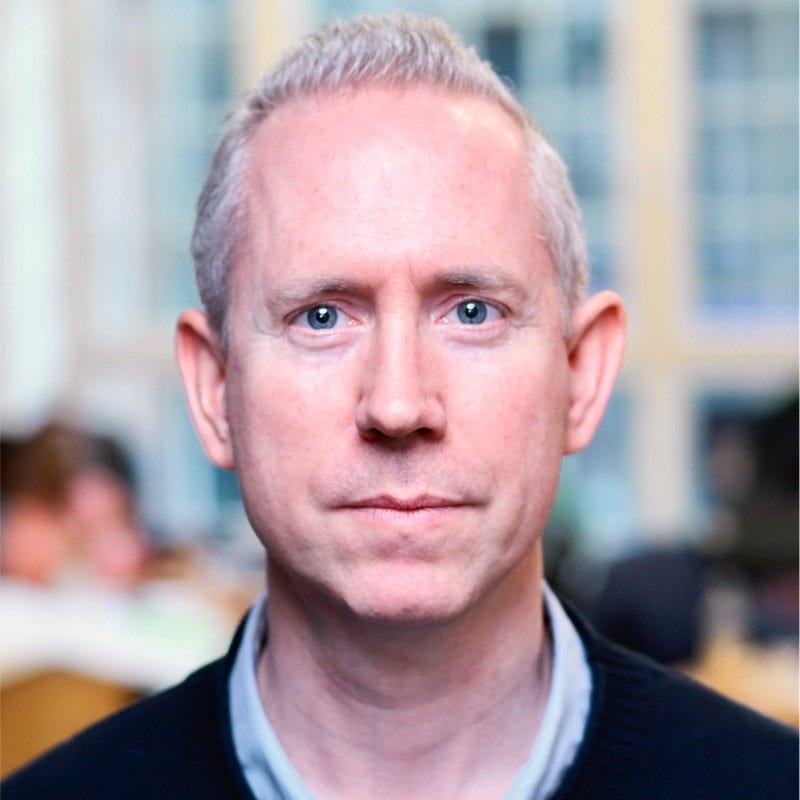
Alistair Starling’s career has taken him from academia to diplomacy and into the people-first coworking industry. He’s worked for the University of Cambridge and served as a British diplomat with the Foreign and Commonwealth Office, building a strong foundation in international relations.
From his own experience of navigating a new city in Tallinn, Estonia, Alistair recognised a common challenge among expats around building meaningful connections in a quieter society. In response, Alistair started hosting informal networking sessions at a trendy cafe every Friday.
For two years, these sessions brought together business, academic, and government people – the “triple helix,” as Alistair refers to it – before it became clear that the community needed a more permanent home.
That new home became Fraqmented, a coworking space in Tallinn that Alistair set up with two entrepreneurs, Cagatay and Markus, whom he met through his networking sessions. Celebrating diversity, Fraqmented welcomes people from all walks of life, working in different industries and from all parts of the globe.
Alistair’s journey reflects a consistent thread: connecting people across boundaries. Fraqmented is a space where meaningful relationships and impactful ideas can flourish. This conversation shares how the coworking space came to be.
1. What sparked the inspiration behind Fraqmented?
Alistair: People move to Estonia for many different reasons. I’m British, Cagatay is Turkish, and Markus is Danish — we all moved here for a better quality of life. But when we arrived, we also shared similar challenges around integrating and getting to know people in a quiet, slightly insular society.
I set up my own networking group to meet people in the city. Every Friday, we had a day of connecting on a Viking long table at the front of a famous art gallery and cafe, owned by a Swedish design company, called Fotografiska.
People could just walk in; there were no rules. It was a triple helix – for government, academic, and business people.
It went on for two years. We started growing and growing, booking the table weekly, but every now and again, the cafe wouldn’t honour our booking, because they’d have a big event and needed the space. We were bringing over 20 people to their cafe every Friday, eating cakes and drinking coffee. After a while, we realised we were getting nothing out of the deal.
We built up a community, and then a lady took it upon herself to become our community manager. I met my cofounders through the Friday networking event, who were sitting at one of the Viking long tables, but I didn’t know them well enough until they approached me to set things up properly. They’re serial entrepreneurs with great ideas, and they felt that I was good at building this network. Within two months of approaching me, we’d set up Fraqmented together.
At the same time, some of our community members expressed that it was hard to get work done in the cafe because everyone was chatting. If they wanted to take a call, they’d sit in a far-flung corner and hope no one would sit next to them. Or they’d sit together at the Viking tables, talking about a business idea, but other people visiting the cafe sat alongside them. They needed something a bit more professional, without it being too straight-laced and corporate.
We knew that Fraqmented would always be larger than the first community, and that some of them would come with us. But others wouldn’t, because although we were moving to a community-first model, we wanted it to be commercial and make a profit.
2. How did you go about finding a physical space for your community?
Alistair: Tallinn is a huge city — it’s where half the Estonian population live. There are a bunch of coworking spaces here, a lot of them being very corporate, but there are also some lovely, beautiful spaces. There are also grungy ones, where you have to be into tech, otherwise you’re not going to fit in. But they’re all awesome.
Finding a space was tricky. We couldn’t afford much, as is usual in coworking, but we just looked around in all the different zones of the city, whether it was the old town in the centre, on the periphery, the tech area, or the central business district.
Coming from hosting events in an ultra-cool, trendy cafe with massive ceilings and art everywhere, we wanted to build a workspace into our own feel. We knew it had to be good for our community and the future.
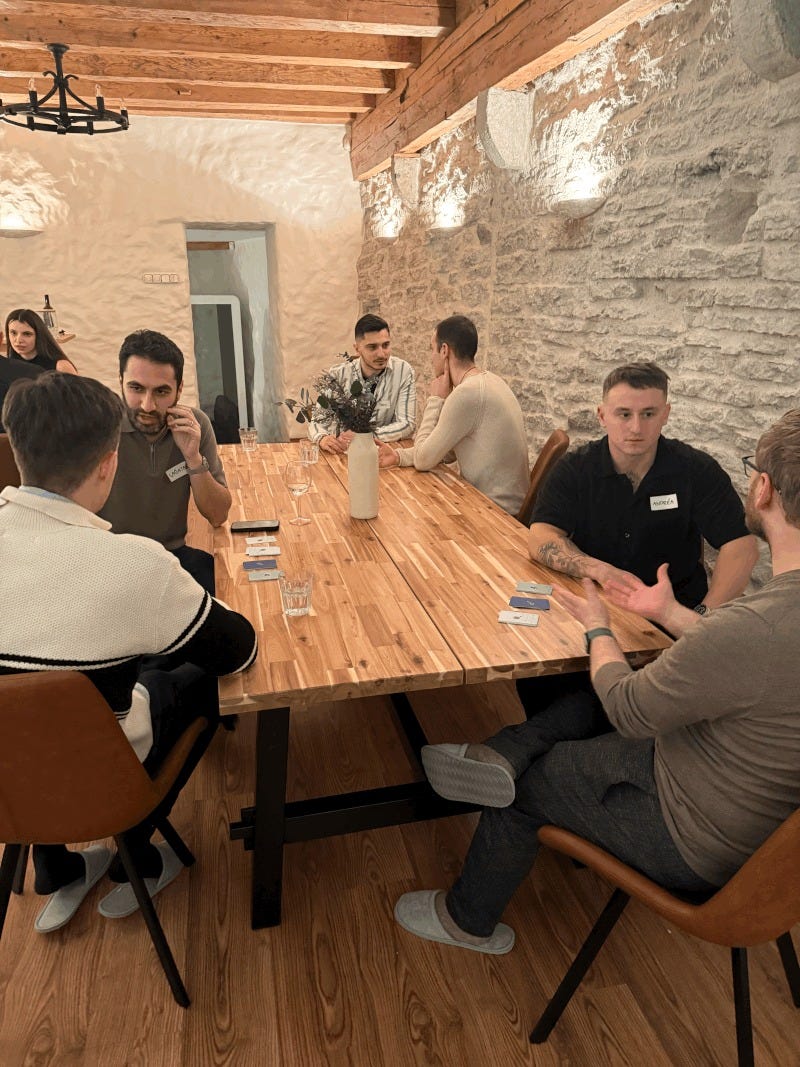
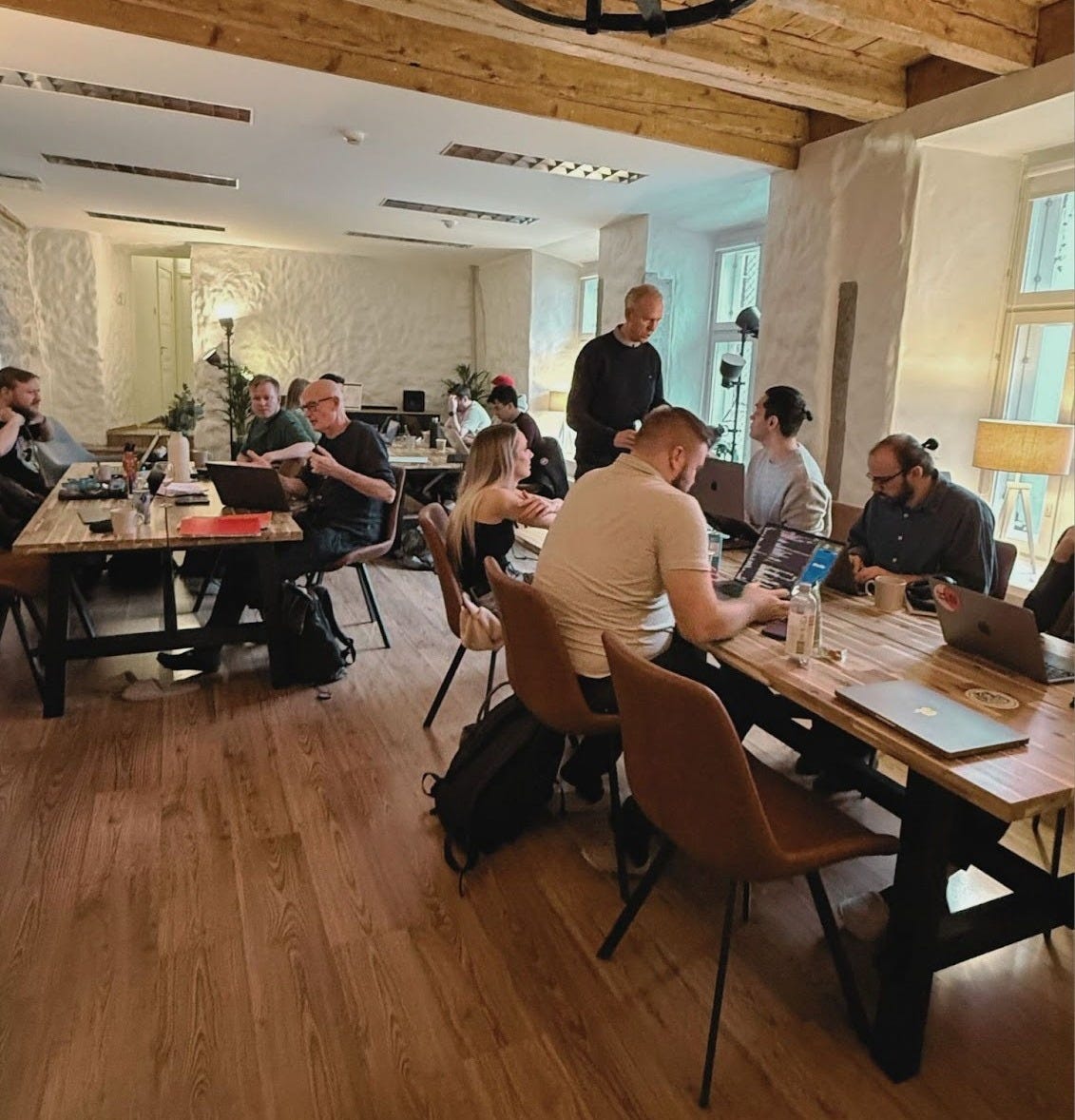
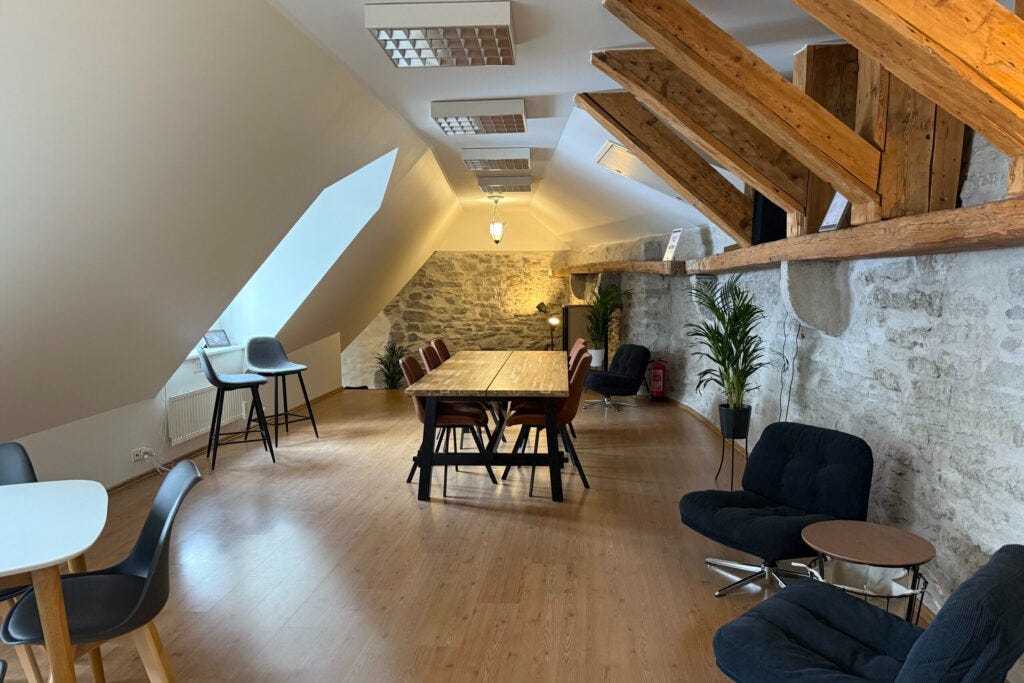
Some of the places we looked at were just shells, others were very corporate. But when we walked into this space, in the middle of the old town, it had wood, stone, a higgledy-piggledy wall, and it was ready and accessible — we immediately said, “Yes.”
At our Friday meet-ups, our community members would talk about business ideas together at one end of the long Viking tables. So we set up Viking tables here. We’ve got several coworking spaces, pods, and a self-serve cafe. Except for our fixed desk room, a lockable office with 10 desks, a couple of meeting rooms, and conference rooms, everywhere is coworking at Fraqmented.
3. Has a specific success story or collaboration come out of the Fraqmented community?
Alistair: It’s not just one, there are loads.
We’ve been open about 13 months, and our members have set up between 12 and 13 businesses between them. That’s roughly one new business a month – it’s big for us.
Four of our members set up a dating business together. Another one is a tech UX company, based at the university. They set up here, bid for some funding, and are now on an incubator course. My cofounders and I have just set up another international relations company. There are so many different examples of people setting up here.
In Estonia, it’s very easy to set up a company, so we all help each other with the questions, like: How do you do that? What’s the best way? How do I save money? Everyone here is working with the same accountants, using our office address, and so on.
Our community just helps each other and combines their skill sets, but they’re small companies. They set up here, but who goes on to survive and become bigger? That’s another question. We’ll see how it goes.
4. How does Fraqmented contribute to the broader startup and tech ecosystem in Tallinn?
Alistair: We’d love to contribute as much as we can. Right now, we do that in two or three ways. One is soft diplomacy: the name, Fraqmented, came about because we bring together fragments of society from different walks of life. Here, we have small, medium, and large businesses, and people from business, academic, and government backgrounds. The fragments are all isolated without the space.
In Estonian culture, everyone keeps to themselves a bit, maybe because of the former Soviet times. But many people coming to Estonia like to experience more of a day-to-day social scene and networking capability. That’s also why we built Fraqmented.
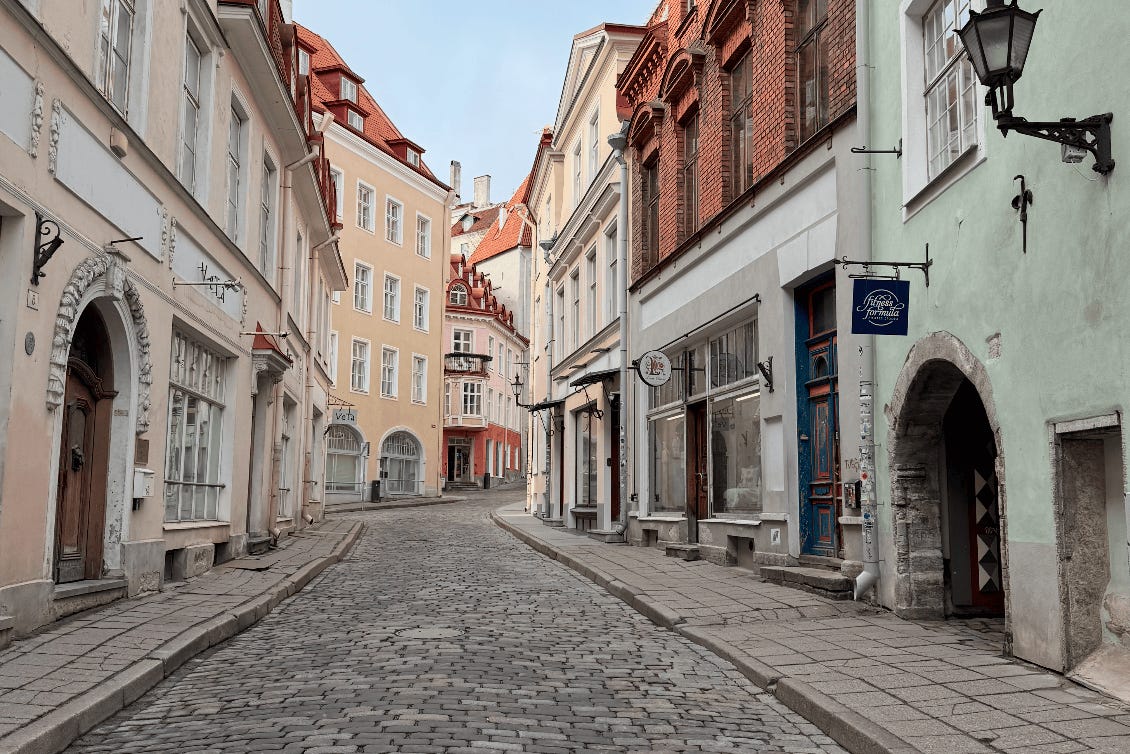
This lends itself to reinvigorating the city centre. Like many other places, there’s been a slight decline in shops and high streets here, but opening in the Old Town, we’re bringing a different kind of clientele who go out for lunch, shop, and head into town every day.
We’re also partnered with the Estonian government’s formal e-residency programme, with two of our co-founders (including me) being official envoys. We’re showing people how that works, and helping them set up their companies in Estonia.
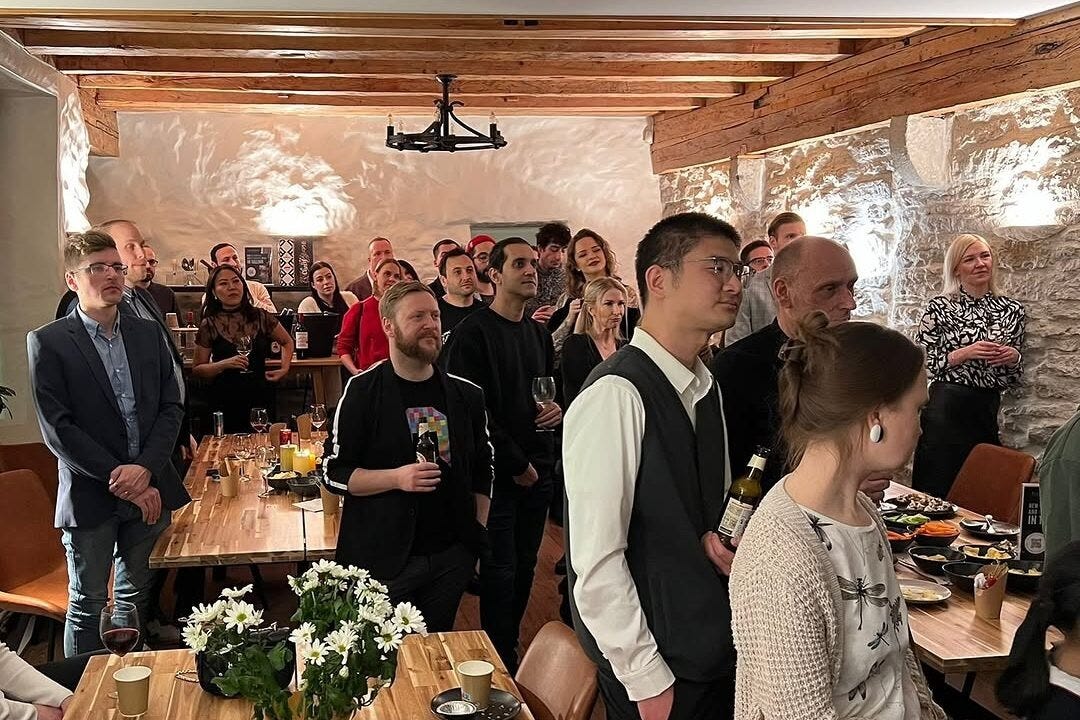
Bringing together these three disparate parts – academia, business, and government – hasn’t really been done on a systemic scale anywhere else in Estonia. You have events around it at universities, but none of the coworking spaces is doing triple or quadruple helix with civil society. They’re either for tech bros or appear very corporate. Meanwhile, we’re all about events, and we’re mixing it up.
When we coined the phrase Fraqmented, the ‘Q’ in fragmented was like the ‘Q’ in LGBTQ+ – it’s all about the diversity within the business sector, and the diversity of people.
We believe we can contribute to the economy by applying disruptive thinking, mixing people together and bringing them to the town centre rather than in peripheral areas. From the centre, you always meet people very easily. We wanted Fraqmented to be in the heart of Tallinn, bringing disparate people together who wouldn’t usually mix.
5. What’s your vision for Fraqmented over the next few years?
Alistair: We’d like to be more visible across the Nordics and globally, not just in one place, so we’re forming alliances to give our members access to Fraqmented when they’re moving around the world. For example, we’ve joined AT World — a German organisation, where we’re part of a global coworking space booking app.
Although we like forming alliances with the city and the government, we need to provide more for the locals, too. There are lots of transitory people here, nomadic people who’ve heard about the tech scene or are part of the e-residency programme. They’ve started an Estonian company, but they then go away a month later.
We want people to stay and be part of a community, and we want to welcome Estonians. Right now, we’re running a campaign targeting Estonians.
We’d like to absolutely nail the triple helix, ensuring people understand its power. It’s not just about being a business person selling to a government person; it’s also about the different ways of seeing the world and thinking.
We’d also like to break even within the next two months and then make a profit. For 13 months now, we’ve been running like a non-profit out of the goodness of our hearts and building this community because we believe in it. We’ve been profitable for three months out of 13, but it’s just up and down.
Now we’ve taken a strategic decision to lose one of our six rooms, which makes us profitable overnight because we’ll switch out a rented pod and buy one instead. We need to turn profitable now, and we’re not ashamed to talk about that.
We always talk about community first, but that’s part of our vision as well. Fraqmented is a business, and we’re helping other people with their businesses – that’s what our consultancy is about. We should be able to run a business ourselves, without losing money.
While those are our visions, we’re not losing sight of why we set up Fraqmented in the first place. We like hosting events, and for external people to take away a little bit of Fraqmentedness with them, and understand more of what we’re all about. We’re a community helping each other, first and foremost, and we’re about diversity.
We only advertise spaces that are within our confines, so we only have space for 70, but if someone wants to run a large event, say for 150 people, we can help you get a good deal through one of our partner spaces.
We’re just trying to become slightly bigger than what we are – that’s what Estonia represents in the world. It’s bigger than what it really is, and we want to lead beyond our authority. Right now, we’re just a little business in the town centre, but we want to be more than that. We want to say something about certain things, work with big charities here, and the founders of unicorns. And we want to do good things.
About People Make Coworking
Celebrating the people who make up the fabric of the global coworking movement, People Make Coworking interviews coworking space founders and community builders who share their journeys of bringing people together.
Edition #26 of People Make Coworking interviews Alistair Starling, co-founder of Fraqmented coworking space in Tallinn, Estonia.