


Inclusion isn’t just the right thing to do – it’s a ‘giant growth opportunity that’s often overlooked.’ This was how Dom Hyams, Global Client Director at Purple Goat, introduced their insightful webinar – Inclusion is Sexy: Let’s Get It On – last week, about inclusion in brand media and marketing plans.
Purple Goat is the world’s only disability-led, disability-inclusive marketing agency with 50% of staff members identifying as disabled. I first became aware of the agency earlier this year, when I joined Dom on a panel discussion called Designing an Accessible Workspace at the Workspace Design Show, hosted by the London Coworking Assembly.
Last week’s webinar, co-hosted by Beth Forsyth, Senior Account Manager, shared some brilliant tips for improving inclusivity in marketing. Some of these learnings I felt were worth cross-referencing in the context of coworking.
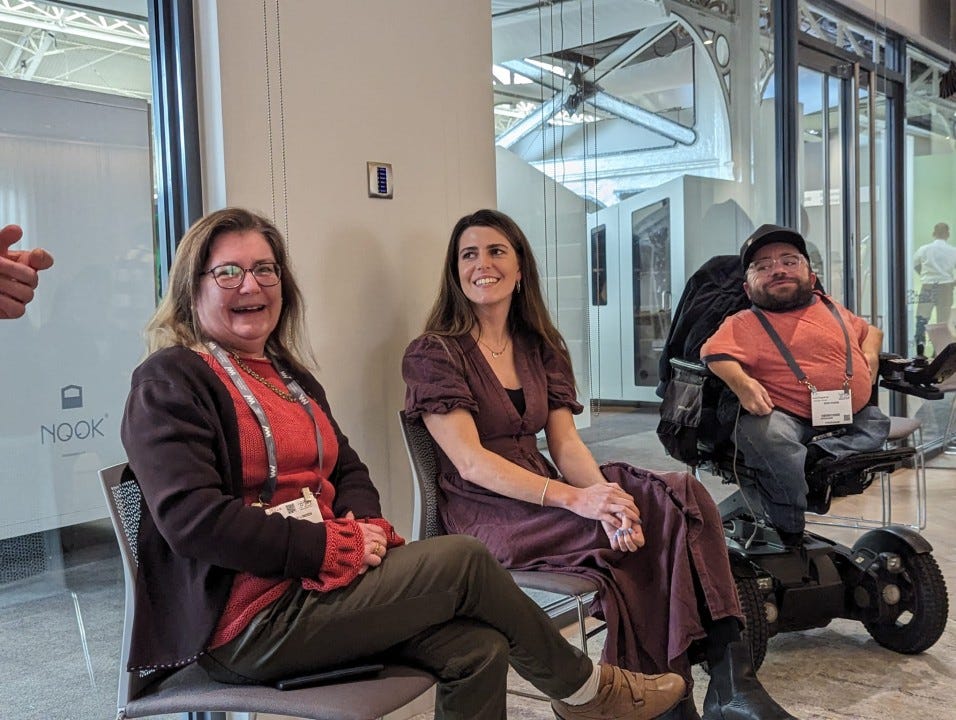
Dom and I on the panel at the Workspace Design Show earlier this year, with Jeannine van der Linden
Why inclusion matters
Although disabled people make up 24% of the UK population, only a poor 0.06% of adverts feature disabled people. Unfortunately, ‘headlines about inclusivity are historically negative.’
However, there are many opportunities around inclusive representation in marketing, such as hearing more diverse voices and encouraging people from doom-scrolling (the habit of endlessly consuming negative news). Promoting inclusivity also facilitates deeper connections. An example is the Assume That I Can campaign for World Down Syndrome Day 2024 (please watch it if you haven’t already).
Like this incredible campaign addresses stereotypes and misconceptions impacting “every aspect of the lives of people with intellectual disabilities,” inclusive marketing efforts should promote the voices and share stories from the disabled community. In many cases, these are lived experiences others haven’t heard before.
Nonetheless, only 32% of adults say they haven’t watched, read, or seen any disability-related advertising content or media in the last six months. This indicates that there is still so much work to do.
Creating inclusive spaces
The webinar advised businesses to partner and engage with the disabled community in their campaigns. For example, Purple Goat recently worked with Virgin Media towards the launch of its new Gamepad – an accessible and exciting gaming experience. With 20% of the gaming community being disabled, and facing barriers relating to the accessibility and the expense of gaming, failure to be inclusive of the disabled community alienates a large customer segment from gaming.
The agency “activated” four content creators who recorded their trip to the Gamepad, and “naturally touched on the accessibility features authentic to them.” They relayed how Virgin has successfully designed a disability-friendly product and an accessible space with adaptable equipment. For example, the Gamepad has space for more people to enter the gamepad, including friends, family, and assistants.
Putting inclusivity first is incredibly valuable. In fact, Purple Goat shared that “76% of customers will feel more loyal to a business that creates accessible products and services.”
It was also expressed: “Your industry might not do inclusivity well, but it doesn’t mean you can’t…” In terms of the coworking sector, the Virgin case study prompts me to ask – how are you engaging with the disabled community and adapting your spaces to suit their needs?
In an episode of Bernie Mitchell’s Coworking Values podcast (recorded ahead of the Workspace Design Show), Dom was asked how coworking operators can improve accessibility in their workspaces. Highlighting that 8% of the disabled population are wheelchair users, Dom replies: “It’s not just the ramps, or keeping the corridors clear. It’s the facility to adjust to people if they need a slightly different setup in that workspace. Do people need a personal assistant with them? It’s about dotting the I’s and crossing the T’s of that experience.”
Not just a tickbox
Inclusivity isn’t simply a tickbox exercise. For example, hiring a British Sign Language (BSL) interpreter for an event for the sake of ticking a box without someone who needs their support present takes the interpreter away from an event or project where their attendance would be necessary for others.
With coworking spaces typically hosting a range of social events to bring the community together, my question from this example is – are you asking event attendees whether they require any assistance during the registration process? Understanding their needs is an important step in ensuring no one feels excluded from your community events.
When we were together at the Workspace Design Show in February, an audience member shared how a wheelchair user had come into their workspace for a job interview, only to find they couldn’t access the office because the building lift couldn’t accommodate their wheelchair. In this instance, it was a community member who overlooked the situation, but operators must take some form of responsibility – how can you prevent a situation like this from happening in your workspace?
Honesty truly is the best policy. We discussed transparency in this panel discussion – it’s unfair to pretend that your coworking space is inclusive of, let’s say, wheelchair users when that’s not the case. Equally, have you communicated the restrictions of your space to your community, so they’re well-equipped in this instance?

Source: Adobe Stock
Inclusivity in coworking spaces
Equally, someone searching for a new workspace might feel excluded if they cannot see themselves as part of your community. This might be unintentional on your part, but someone with disabilities will immediately feel alienated if they don’t see the information they require to know that your space can accommodate them. During the panel discussion, the WelcoMe app was recommended — it’s a directory of accessible places for people with disabilities.
Meanwhile, the webinar highlighted the underrepresentation of inclusive imagery in visual media and across websites. Again, in the context of coworking — do your website and social media images truly represent your coworking community? Have you provided any content that will reassure someone with disabilities that your workspace is inclusive of their needs?
Again, you can engage with people with disabilities, asking them whether your online communication sufficiently covers what they’d be looking for when planning to visit your space. After all, ‘23% of people felt that the representation in advertising they saw of disabled people reflected their experience of disability.’
This again highlights how important it is to engage with the disabled community when striving for true inclusivity. The accessibility of online content is already fairly compulsory but come next year, you’ll need to improve accessibility of your website and media content. Coworking software company, Cobot, recently shared a useful article about these new regulations around online accessibility – it’s worth a read!
The point about gaming being too expensive makes me wonder whether rising rates of flexible workspaces and coworking spaces restrict the disabled community, (particularly the self-employed), from joining a workspace community. The Purple Pound – an initiative promoting the collective spending power of the UK disabled community, valued at £274 billion – highlights that the disabled community is “fiercely loyal to disabled friendly organisations.” Similarly, the webinar expressed: “57% of consumers are more loyal to brands that commit to addressing social inequities in their actions.”
What’s next to embrace true inclusivity
So, why aren’t all businesses wholly inclusive in their marketing and operational efforts, and bringing disability-friendly products and services to market? The webinar exposed reasons including fear of doing something wrong and the cost implications. But, many businesses do nothing at all. The advice was – to be open to learning and iterating, and do what you can.
Education is a good step forward, I found Purple Goat’s webinar truly enlightening in this sense. It urged ‘bringing diverse voices into the conversation, don’t just guess how someone will feel.’ Here, I’ll hold my hands up – I need to do so much more to really understand the needs of the people I’m writing about in my content.
In 2025, the disabled community would like to see greater representation of inclusion. With campaigns including World Down Syndrome Day 2024 and media coverage around the Paralympics in Paris recently, there’s a shift towards greater inclusivity. This must continue into the new year and beyond.
Collectively, we can all do something – I hope this article is a helpful step for you in your mission to become more inclusive.