


After graduating from the Royal College of Art, Michael Korn built and spun out a hardware company called KwickScreen (an award-winning, portable, retractable hospital screen product). While designing and selling it was assumed to be the hardest part of running the business, the real challenge was manufacturing KwickScreen in the UK, especially in London.
Looking around, Michael saw countless other inventors and innovators struggling with the same barriers: brilliant ideas constrained not by creativity, but by infrastructure. That became the foundation for Blue Garage.
Housed in a rare industrial building on Lewisham’s high street, Michael has built an affordable makerspace in the heart of the capital. Blue Garage has evolved into a home for hardware startups, creative manufacturers and makers who want to prototype, produce and scale – all within Zone 2.
In this interview, Michael shares how Blue Garage flips the traditional coworking model on its head, supports companies that struggle to access affordable manufacturing facilities, and the exciting opportunities the makerspace brings to Lewisham.

1. What sparked the concept of Blue Garage, and why build it in London specifically, rather than a smaller town or industrial area?
Michael: The concept was to create the environment and support that I wish I had when starting my company. Looking back on the success of my business, the hardest thing to overcome wasn’t making the product, but manufacturing it in the UK, especially while living in London.
I empathised with these brilliant inventors and creative startup businesses around me, and their challenge of spending money on overpriced, unnecessarily large spaces and signing up for long-term leases. I thought I was the right person to fix that problem.
Lots of creative people start their businesses in London, often after university. There’s a huge demand for space for early-stage startups, but there’s hardly any supply. Everything is so expensive here, and buildings are often converted into flats or offices.
There are fewer makerspaces, creative spaces, and opportunities for people to scale their business on their terms, rather than under the banner of another accelerator with its own agenda.
I wanted to create something independent and to help startups by providing equipment and space at the lowest possible cost. We needed something large, but also accessible, and on the high street.
Most industrial spaces are on a soulless industrial estate. Everybody’s driving there; it’s impossible to get the train, and you’re not part of the community. The buildings themselves are normally big, empty sheds, with companies stacking them high with racks and shipping boxes. At Blue Garage, we wanted something accessible with character, on a high street in an up-and-coming area.
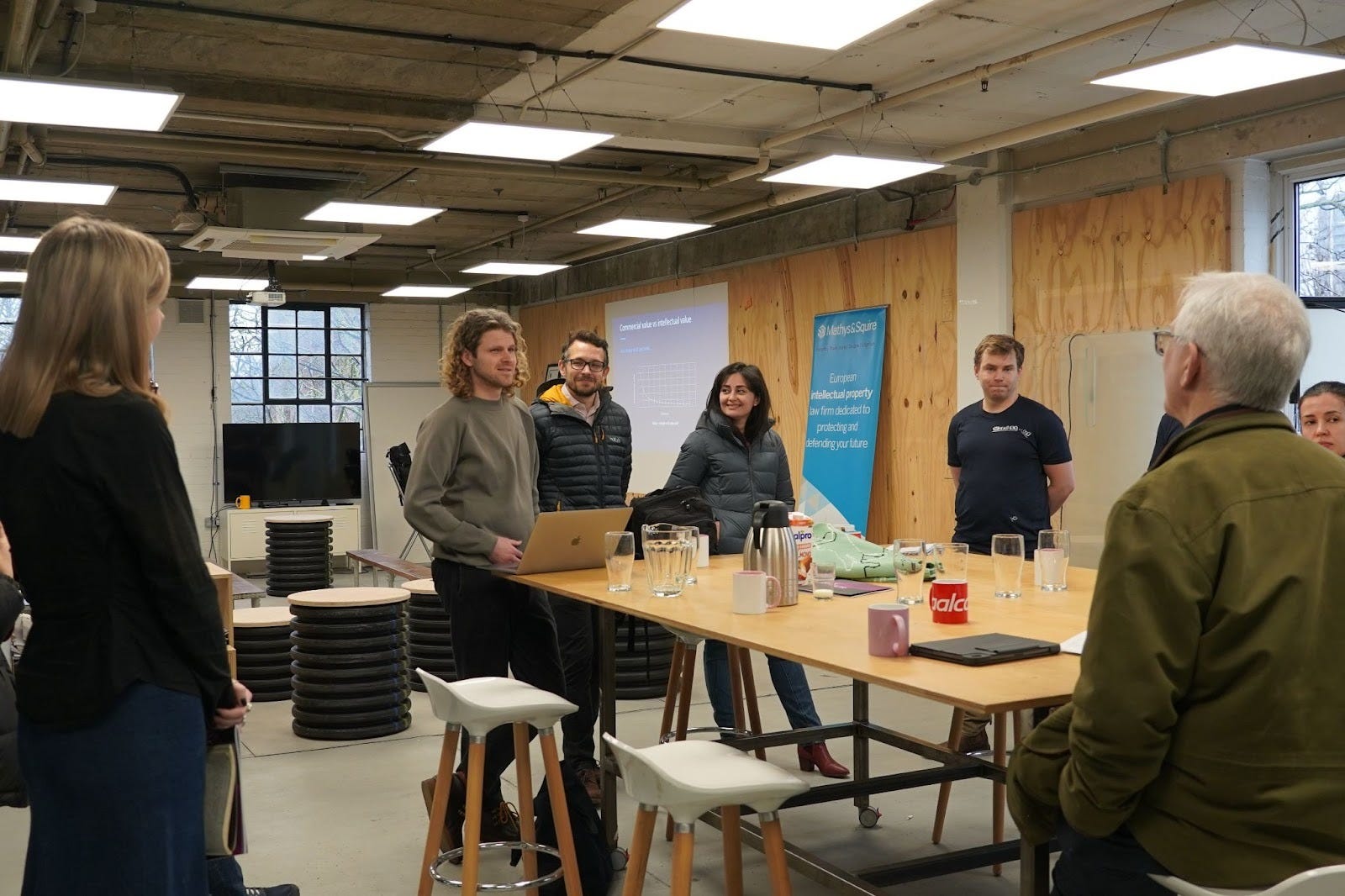
We looked at many buildings, but there was nothing like the one we found in Lewisham. It was the perfect fit for us – an industrial building with three huge concrete floors, a lift that goes between them all, and a big delivery bay.
It’s ideal for lots of small companies, but not for one big company, and it can’t be converted to flats or offices. This building can’t be used for much else.
2. What makes Blue Garage unique as a makerspace?
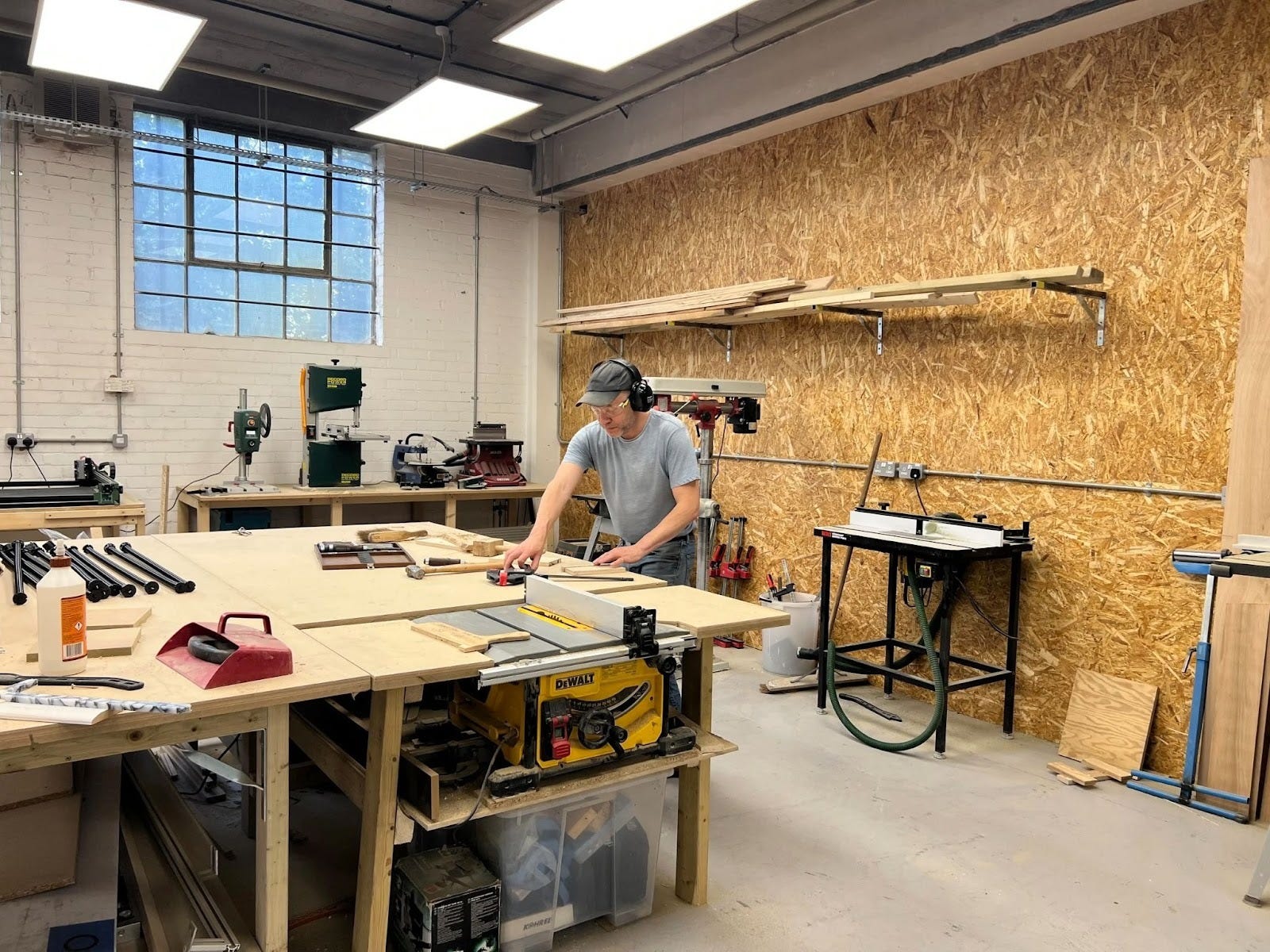
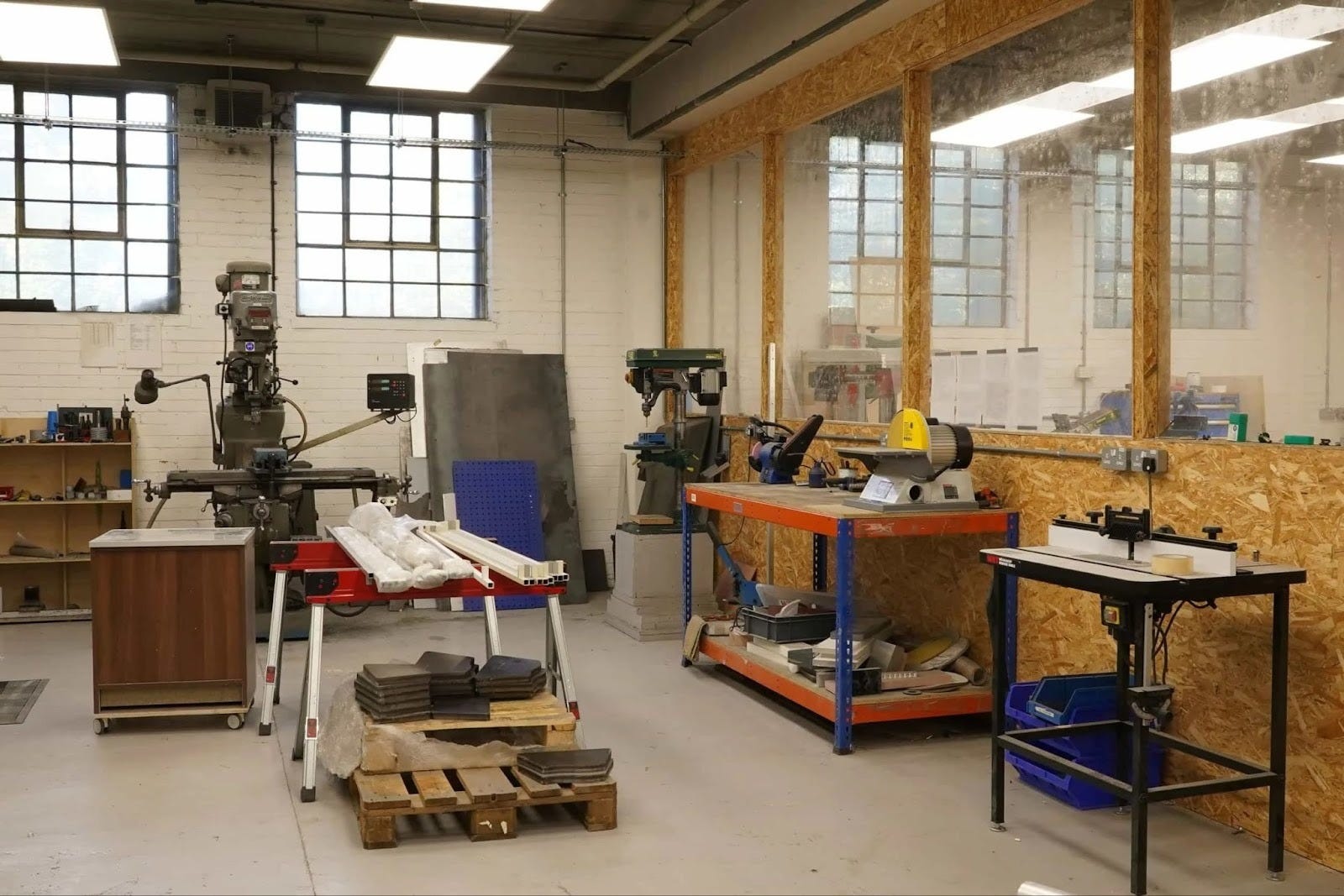
Michael: We have a factory in a box. At Blue Garage, our main uniqueness is having millions of pounds of production equipment and prototyping equipment. It’s the kind of thing you’d have in a factory up in Leicester (I used to drive up to a factory there to use a large printer), or for someone with a well-kitted garage out in the suburbs.
We’ve got lots of sophisticated tools – a sewing lab, textile equipment, screen print facility, a massive woodworking room, metalworking room (with welding for aluminium and steel), and a large general assembly area. All the things anybody could dream of prototyping, we’ve got in this building.
Our people are founders who’ve created a new product that will change the world and who could scale up to become a large manufacturing company.
Inventors and innovators struggle to scale their business, partly because it’s difficult to develop and produce a physical product. As soon as you have to physically make hardware or products, it introduces new challenges. But if you can break through and develop a new physical product, the opportunities are amazing.
Some of the best global companies are based on physical products. Often, the ones doing something technically difficult or that involves manufacturing can have a big impact, so it might be a med tech product, a new climate tech material, or a fashion brand – all sorts of things.
Blue Garage combines technical, manufacturing and commercial ambition. The people we’ve really designed our space for could change the world through physical products – freelancers, designers, engineers, and creative entrepreneurs. Think of the people who built the companies of today: James Dyson, Steve Jobs, and Yvon Chouinard.
The name Blue Garage takes after all the tech companies in Silicon Valley that started in a garage. We’re the London ‘garage’ for hardware companies, and we’ve got big blue garage doors. We support creative entrepreneurship and the ‘garage’ ambition of scaling a new company. The best ideas come out of the blue.
Many things prevent people from building ambitious, successful companies. A big part of our mindset at Blue Garage is to reduce the physical limitations of a scale-up manufacturing company.
Being surrounded by ambitious people rubs off on you, and it’s really exciting to be part of the wider ecosystem of independent coworking spaces in London. We offer a virtual membership so people can use the makerspace and have their own office. They’re probably not building a hardware startup, but perhaps they need somewhere to fix their bike, do some DIY, or work on a part-time side hustle.
We’ve got about 10 different clients manufacturing products who previously lived in London and made things much further away, often abroad. Blue Garage enables people to receive and ship a volume of product, and still be in Zone 2. Getting things made locally is much easier and faster.
3. Is there a crossover between traditional coworking and what you do here?
Michael: I didn’t start by building a coworking space, but by building a shared factory for manufacturers. The coworking element came from having all the infrastructure and thinking of ways to get as many people into the building to use it.
Normally, a coworking space that calls itself a makerspace will have coworking amenities, and then 3D printers in the corner, a woodwork room, and a messy room. We’ve equipped ours the other way round.
What haven’t just got all this incredible equipment, but a wonderful community that built itself in an independent, coworking environment. People stay at Blue Garage because they didn’t realise they would find connections, friends, support, contacts, and expertise from other people in the building.
We’ve got hot desks, so more people are joining Blue Garage just for that, or to rent an office, but they’re not using the makerspace, which is an extra bolt-on. Someone recently told me, “This community has more soul than any of the other coworking spaces I visited.”
If everyone’s working on their computers all day, every day, then you meet up at the coffee machine or the water cooler. But you’ll bump into each other more if people are welding, printing and sewing.
As you need to carry things and get things delivered here, you’ll help each other out more. It ends up being a much more interactive community because people’s work forces them to help each other, and that builds relationships.
4. What has been one of the biggest challenges in running and sustaining a makerspace like this?
Michael: It’s very expensive to establish and run a makerspace. We’re not just computers, desks, and utilities; we provide top-of-the-range equipment and health and safety technicians. Half the space is dedicated to these shared facilities.
Initially, getting enough people in to cover the costs was challenging. But, we’ve now reached one year of self-funding. We’re covering the rent, and we’re profitable, growing, expanding, building more offices, and looking for more locations.
What Blue Garage has created in Lewisham covers most of South London, with people travelling from central and Zone 1 down to the southeast. There’s potential and demand in other parts of London, so we might have another two Blue Garages in London, with others outside the capital.
Our model lends itself to a whole network of innovation commercialisation hubs, supporting all types of creative entrepreneurship and makers.
5. What kind of community do you see forming here, and how does it reflect the neighbourhood?
Michael: I’ve lived in London my whole life, but as I’m not from Lewisham, I welcomed everybody here, and that’s brought lots of new companies to the area.
Through opening Blue Garage, we’ve discovered all of Lewisham’s different communities. Loads of people said they’ve lived in Lewisham their whole life, but never imagined that something like this would be here. It’s exactly what they’ve always wanted.
Being one stop from London Bridge, Lewisham is easy to get to, but it’s one of London’s lowest job density boroughs, so many Lewisham residents commute for work. Now, the perception of Lewisham is changing, and we need to create more jobs for its residents.
There are some really deprived neighbourhoods in Lewisham, and within them, many talented, ambitious people who don’t have the opportunities to pursue their ambitions. This is the community we’re tapping into now.
For example, we’re bringing a music recording studio to the space, in the hope that it attracts young people through music. People participating in that programme will hopefully get involved in other parts of the building.
Blue Garage is an inclusive melting pot of talented, ambitious people. The only entry requirement is your attitude to being in a shared space and a shared community. The more differences, the better it is for everybody.
About People Make Coworking
Celebrating the people who make up the fabric of the global coworking movement, People Make Coworking interviews coworking space founders who share their journeys of building communities and workspaces.
Edition #24 of People Make Coworking interviews Michael Korn, founder of Blue Garage in Lewisham, UK.